
Quality standards and certification
in PET recycling
We develop processes, audit quality, and implement solutions that support safe, repeatable, and compliant rPET materials.
Certificates
Learn more about the certificates that attest to the highest quality of our products.
REACH
The European REACH directive (Registration Evaluation Authorisation and Restriction of Chemicals) aims to regulate the circulation of chemical substances within the European Union. Its main objectives include the registration of chemical substances by companies, assessment of their impact on health and the environment, authorization of hazardous substances, and restriction of the production or use of substances deemed harmful. REACH is a comprehensive chemical risk management system striving to protect human health and the environment, while ensuring access to safety information for businesses and consumers.
EFSA Approval
EFSA (The European Food Safety Authority) is an independent agency of the European Union responsible for scientific risk assessment of chemicals used in plastic production, especially those in contact with food. Its approvals confirm product compliance with safety standards, enabling legal market entry within the EU.
FDA Approval
A certificate granted to products that have received approval from the American Food and Drug Administration (FDA). Awarding an FDA certificate signifies meeting the highest standards of quality and safety. Compliance is verified by the federal regulatory institution part of the U.S. Department of Health and Human Services. The FDA certificate guarantees compliance with strict industry norms.
BPA-Free
Product free from bisphenol A (BPA) – a chemical substance used in plastic production. BPA is associated with potential health risks. BPA-free products such as bottles or containers are preferred for health reasons.
R&D
We conduct research, acquire new knowledge, and develop technology.
Research and Development (R&D) plays a key role in creating innovative solutions, developing new products, and improving existing technologies. Ongoing research enables the company to maintain market competitiveness and pursue long-term growth and success. Research work is carried out in cooperation with scientific centers, including Poznań University of Technology, Silesian University of Technology, and Bydgoszcz University of Technology.
Technology optimization and implementation of industrial practices regarding PET waste processing
Intensification of the rPET extrusion process through optimization of the rPET homogenization process
Development of an improved rPET polycondensation model
Development of an innovative method for parameterizing and separating PET objects
Development of a plastic shredding model with liquid participation
Plastics Market
Closed loop, our participation.
The essence of a closed loop in the domestic market lies in maximizing the use and minimizing the waste of economic resources. In practice, this means recycling domestic raw materials, reducing dependency on imports, and limiting the negative impact of resource exploitation. A circular economy is realized through the implementation of a waste management system focused on maximizing value recovery from waste via recycling, energy recovery, and avoiding landfilling.
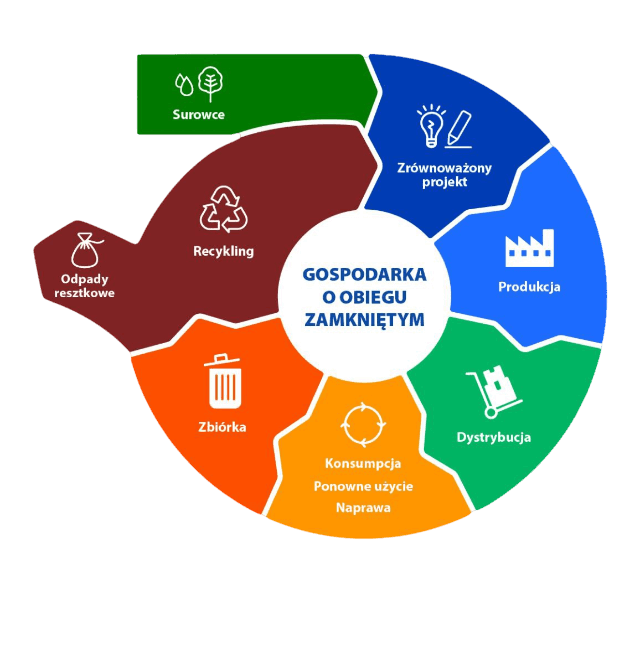 Source: https://www.europarl.europa.eu/
The SUP directive sets specific targets for collecting PET packaging waste, defining a minimum collection level of 77% by 2025 and 90% from 2029. It also introduces mandatory recycled content in new PET packaging starting from 25% in 2025, 30% in 2030, and 65% in 2040. SUP is directly linked to the introduced Plastic Tax on non-recycled plastic packaging. The tax aims to prevent the harmful impact of certain single-use products on the environment and protect human health. Plastic Tax introduces an incentive system based on the principle: the less to landfills, the less we pay.
In 2020, the average use of recyclates in newly produced PET bottles reached 17%. In Poland, the waste management system relies mainly on Mechanical-Biological Treatment (MBT) plants located in various regions. Due to market fragmentation and lack of concentrated streams, effective stream management is difficult. Installations processing waste streams are characterized by varying capacity and technological advancement, which often leads to skipping valuable fractions.
A series of changes and commitments Poland must meet in the coming years result from the introduction of a deposit system for single-use plastic bottles starting in 2025. This system includes plastic bottles up to 3 liters, glass bottles up to 1.5 liters, and metal cans up to 1 liter. Additional consumer pressure to introduce sustainable practices by main producers fosters the transformation towards a Circular Economy (CE), which becomes a priority for companies that have made declarations regarding a sustainable approach to production and packaging. The introduction of a functional Extended Producer Responsibility (EPR) system relieves municipalities and the recycling sector, shifting the risk to producers. However, to achieve sustainable waste management goals, coordinated actions at national and local levels are necessary.
